Still Stacking Pails By Hand? Here’s Why a Pail Denester Is the Upgrade Your Line Can’t Afford to Skip
A pail denester is the kind of machine that nobody outside of manufacturing has heard of, yet inside a production facility it can be the difference between a filling line that runs smoothly and one that stutters every few minutes waiting for an operator to wrestle the next pail off a stack. If your line still relies on manual pail separation, you are paying for a bottleneck that has a straightforward, cost-effective solution.
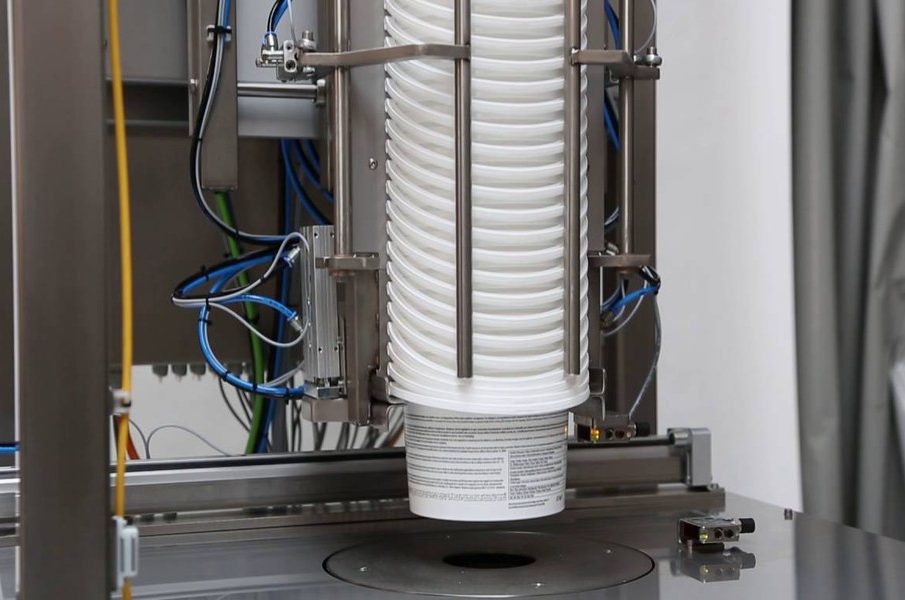
The pail denester does exactly what its name suggests. It takes a stack of nested, empty pails and separates them one at a time, placing each onto a conveyor that feeds into the filling station. This simple automation eliminates one of the most persistent sources of downtime on pail filling lines: the manual handling of empty containers.
The Manual Handling Problem
Empty pails arrive at manufacturing facilities in nested stacks, typically ten to twenty units high. Before a pail can be filled, it must be separated from the stack and positioned under the fill head. In manual operations, a worker performs this task by hand.
The problems with this approach multiply under production pressure.
Speed limitation.
A human operator cannot separate and place pails as fast as an automated filling machine can fill them. The operator becomes the pacemaker for the entire line, capping throughput below the machine’s capacity.
Inconsistency.
Pails that are tightly nested resist separation. Operators develop their own techniques, some faster and more effective than others. Shift changes and fatigue introduce variability that disrupts line rhythm.
Injury risk.
Repetitive gripping, twisting, and lifting of pails causes strain injuries in the hands, wrists, and shoulders. These injuries develop gradually and result in absenteeism that further reduces available labour.
Contamination.
In food, pharmaceutical, and chemical applications, manual handling increases the risk of contaminating the inside of the pail before it reaches the filling station.
A pail denester eliminates every one of these problems.
How a Pail Denester Works
The machine receives a stack of nested pails loaded by an operator or by an automated pail magazine. Mechanical grippers or vacuum cups engage the bottom pail in the stack, separate it from the one above, and place it onto the outfeed conveyor. The next pail in the stack drops into position, and the cycle repeats.
Modern denesters handle a range of pail sizes and materials, including plastic and metal containers. Changeover between sizes is typically achieved through simple mechanical adjustment rather than extensive retooling.
The cycle time of a quality denester exceeds the speed of most filling machines, meaning the denester is never the bottleneck. It feeds pails faster than the filler can process them, creating a buffer that absorbs minor disruptions without stopping the line.
The Production Impact
The impact of adding a pail denester to an existing filling line is immediate and measurable.
- Increased throughput. With pails fed automatically at a consistent rate, the filling machine operates at or near its rated capacity without waiting for manual loading.
- Reduced labour. The operator previously assigned to manual pail separation can be redeployed to a higher-value task elsewhere on the line.
- Improved consistency. Every pail arrives at the fill station in the same orientation, at the same interval. This consistency reduces fill errors and improves overall equipment effectiveness.
- Lower injury rates. Removing the repetitive manual task eliminates the associated ergonomic injuries.
As Lee Kuan Yew once said, “Excellence is achieved not by chance but by dedicated effort.” Dedicated effort in manufacturing means identifying and eliminating the inefficiencies that hold production back.
When to Invest in a Pail Denester
The decision to automate pail handling is straightforward for any operation meeting these criteria.
- Filling more than 200 pails per shift. At this volume, manual handling becomes a measurable constraint on throughput.
- Running a filling machine that waits for pails. If your filler has idle time between cycles because pails are not arriving fast enough, a denester closes that gap.
- Experiencing hand and wrist injuries. If your safety records show ergonomic injuries linked to pail handling, automation is the most effective intervention.
- Planning to increase output. If future production targets require higher line speeds, automating the pail feed now prevents the need for a more disruptive upgrade later.
Choosing the Right Denester
- Pail compatibility. Confirm that the machine handles all pail sizes and materials in your product range.
- Cycle speed. The denester should exceed the cycle speed of your filling machine to prevent it from becoming the new bottleneck.
- Stack capacity. A larger magazine reduces the frequency of stack reloading, allowing the operator supervising the line to manage other tasks between reloads.
- Changeover time. If you fill multiple pail sizes, the denester should switch between them quickly and without specialised tools.
- Integration. The denester must connect seamlessly with your existing conveyor system and filling machine. A packaging equipment specialist can assess your line layout and recommend the optimal configuration.
The Bottom Line
A pail denester is not a glamorous piece of equipment. It will not feature in your annual report or impress visitors on a factory tour. But it will quietly eliminate one of the most common and most tolerated sources of inefficiency on a pail filling line. If you are still separating pails by hand, the upgrade is overdue. The cost is modest. The payback is fast. And the improvement in line performance is something your team will feel from the very first shift.